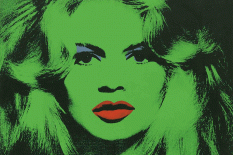
Warhol first met Bardot at the Cannes Film Festival in 1967 when she actively supported his attempt to show The Chelsea Girls there after the original planned screening had been cancelled. In 1973, at the height of her fame, she announced her retirement from making films. That same year Warhol received the commission to make her portrait. At the time he was shifting his focus from filmmaking back to painting, and perhaps viewed her coincidental screen exit as the perfect opportunity to commemorate and idolize her in art.
Shows & Exhibitions
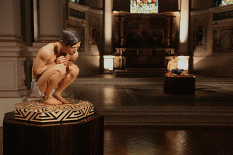
The Iranian-born British artist and photographer Reza Aramesh makes Catholic-style statues based on figures – often Muslim captives – that he finds in press photography from conflict zones, mostly the Middle East. He uses the photographs to produce highly detailed iconic figures of human suffering which will be shown for the first time in Europe in a former church in London, Oct 13-16.
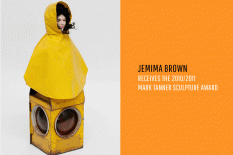
Jemima Brown is known for her sculptural explorations of the animate versus inanimate, orchestrating the complex visual narratives involved in self- (and indeed other- ) creation. The Tanner Award has facilitated significant developments at a pivotal point in Brown’s practice, particularly in experimenting with resizing the sculptures, to investigate the role of scale, surface and materials within formal sculptural decision-making, and how these questions intersect with the more narrative elements in the work.
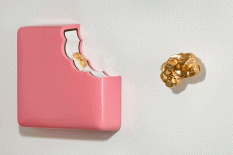
Continuing with their exploration of ideas of material value and the consequences of the actions we take to satisfy our desires, Berg-Myers have created a new body of works. This current exhibition is meant to provide the viewers with objects-situations where our choices are put to the test in how we understand the value of the things we do.

In the last thirty years of the Soviet Union, Koretsky’s art sought to ensure world Communism’s moral health. In contrast to more conventional Soviet propaganda—filled with happy workers, glorious leaders, and uplifting slogans—Koretsky created striking scenes of survival and suffering that were designed to create an emotional connection between Soviet citizens and others struggling for civil rights and independence around the globe.
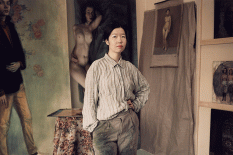
For the first time ever, five photographers have been shortlisted for the £12,000 Taylor Wessing Photographic Portrait Prize, the major international photography award. Firmly established as the leading showcase for new talent in portrait photography, the prize is sponsored by international law firm Taylor Wessing.
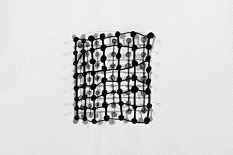
Susan Hefuna’s work reflects experiences in-between cultures, dealing with cross-cultural codes; she constantly plays at what images mean and how they work, creating dream-like spaces where viewers can attach a wide array of significances to indicators of time and location. Hefuna hijacks the viewer beyond space and time, and from a taste of the undetectable, generates an arrangement of a direction of sorts. The lattices and correlations made on paper trace a journey, each line a new course.
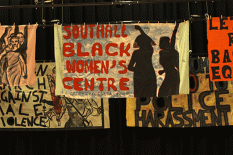
A new video-installation, Sisters! is a collaboration between Swedish artist Petra Bauer and the Southall Black Sisters - the radical, pioneering London-based feminist organisation, who since 1979 have politically engaged in the contemporary social and political conditions of black and minority women. Sisters! is not a film about the Southall Black Sisters, but is a two-way project between Bauer and the staff at the organisation.
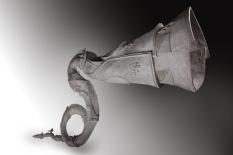
Assar Art Gallery is announces Heyrat [Wonder]*, an exhibition of new sculptures by Reza Lavassani. Known for his paintings and enigmatic papier-mâché sculptures, Lavassani displays his own visualization of subjects inspired and taken from old stories, fables, symbols and poems rooted in Persian culture. His work is heavily influenced by old literature and poetry and this fascination with the past, his sense of inventiveness and versatility has resulted in works of intense drawings, oil paintings and amazing sculptures throughout his career as an artist.
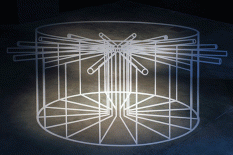
Ergin Çavuşoğlu's exhibition, Alterity, considers the human impulse to see pattern and meaning in otherwise random events, examining this hermeneutic urge as both an inbuilt intellectual reflex and a means of consolation in an arbitrary, indifferent universe. The exhibition itself consists of a number of disparate elements. Unveiling a number of new pieces alongside highlights from his repertoire of video works, Çavuşoğlu retraces recurring preoccupations in his practice and shows older work in a new light.